

Vacuum Drying in a Monolithic Dome
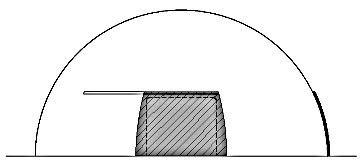 The door mounts on the outside of the facility to keep from being sucked off the building. It could be designed to slide on a track on the domes' exterior. |
 The lower floor is the "pressure floor" to prevent uplift. Without it, the dome will uplift due to the pressure of the vacumm. The space between the pressure floor and the wearing floor is filled with gravel and/or fill dirt. |
March 22, 2005
by David B. South
It is a basic fact of physics that the boiling point of water lowers as the atmospheric pressure lowers. Water boils at 212 F at sea level but it boils several degrees cooler in high altitudes. That is why it takes longer to boil an egg in Denver than it does in Houston.
If you depress the barometric temperature, drying is faster with less heat needed. The vegetable industry has learned this and uses it in their vacuum drying facilities. They put produce to dry into a vacuum chamber then pull the vacuum on the chamber. It takes less energy to pull the moisture out of the vegetables using this method.
The current wisdom says it is not very effective to build a vacuum chamber much larger than the size of a truck body.
However, it is possible to build Monolithic Domes to sustain substantial amount of vacuum pressure. At present no one has requested a large vacuum chamber. We want everyone to know we think we can do it!
The Monolithic Dome needs to be a total sphere or the floor would lift inside. A false floor is poured inside the sphere.
A large vacuum chamber could be used for drying lumber or mass drying of animal fodder in areas where the atmosphere is too wet to achieve field drying. A large vacuum chamber could also be used to study physical phenomenon. Obviously these are just a few ideas on how a large vacuum chamber could be utilized. We leave it to the reader to come up with reasons of their own.
Related Links:
- Index of Larger Monolithic Dome Projects -- Partial List In Alphabetical Order by State
- Protect Your Potatoes
- Dome Technology's Bulk Storage Update
- Fertilizer Blend Plants -- A Growing Demand
- Anatomy of a Bulk Storage
- Move the Processing Plant Indoors
- Tunnel to a Lower Budget
- Biological Containment
- Free Bulk, Cold, Freezer or Other Storage Facility Project Evaluations
177
Dome Park Place - Italy, TX 76651
Tel (972)483-7423 - Fax (972)483-6662
 | Press Room