

Domes for the World and A Trip To Morocco
"We hear a lot of talk these days about sustainable development. We have the tools right now to turn these catch phrases from rhetoric to reality." -- Rebecca South
January 23, 2006
by Rebecca South & Freda Parker
Click any image to enlarge |
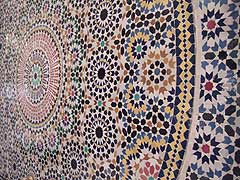
| Very common mosaic pattern in Morocco. You see beautiful mosaics like this everywhere. |
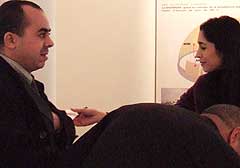 |
| Aweh is very professional and handled the crowd with grace and finesse. |
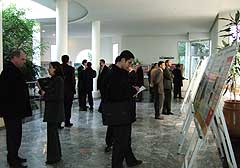 |
| Here you can see the displays of the competitors in the architectural competition. |
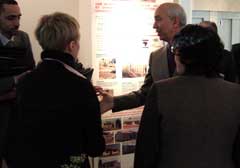 |
| Pictured here is the moment we met the Prime Minister. |
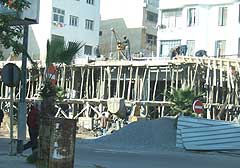 |
| A standard construction site. Many of the buildings in progress were constructed out of a steel frame, hollow bricks and plaster. |
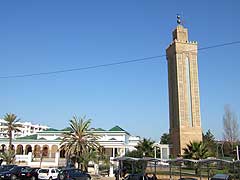 |
| A very beautiful, new mosque just outside the Ministry of Housing. The details of the minaret are outstanding. |
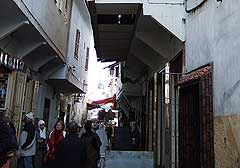 |
Typical street scene in the outdoor market area of Rabat. |
Note: In December 2005, Rebecca South traveled to Morocco for an all-day exposition and competition, during which builders from various countries displayed their designs.
Rebecca went representing Monolithic's Domes For The World Foundation (DFTW) and as a guest of Louisa Idiri. Louisa owns Alchems, a chemical company headquartered in Paris, France. She and her son Toufik attended one of our 2005 Workshops and became very interested in EcoShell housing for developing nations.
Besides Rebecca, Louisa's Moroccan party consisted of three others: Nano, Alchems' engineer; Toufik; and Aweh, a female friend and associate of Louisa's. On December 16, the five went to the ministry of housing to set up Alchems' display, including a DVD and slideshows on Monolithic Domes and EcoShells.
While most of the exposition's participants were involved in the architectural competition, during which a winning structural design was chosen, Alchems was not. Yet, Alchems was given special treatment and a priority display near the entrance/exit of the building. Rebecca said, "Alchems was invited by the King and the Minister of Housing to present the EcoShell concept for use in rebuilding areas where the living conditions need to be improved. They're really interested in making things better."
Initiated as part of King Mohammed VI's improvement program, Morocco currently has a Cities Without Slums program that according to its website (www.citiesalliance.org) is "... aimed at reducing social disparities ...."
Here is a summary of Rebecca's trip diary and pictures she took during her visit to Morocco:
December 14: I arrived in Paris at 10:30 yesterday morning. It took two hours to get off the plane and get my luggage. The accountant from Alchems met me. We went straight from the airport to their office on the Left Bank, quite close to the Eiffel Tower. We talked business. Louisa wanted to show me some other technologies she would like to integrate into a plan for a "Complete Village," like forms that go under foundations to reduce humidity and radon gas, water condensers that make potable water out of the air, and a chemical which can be sprayed on dirt roads that forms a hard shell and reduces dust and erosion.
I had a late lunch with Louisa. At around 5, I took a taxi to my hotel, which was perfect. It is called the Eiffel Capitol Hotel and is on a typical one-way street, very close to the Dupleix metro stop.
The room is soooo small -- quaint, if you will. I couldn't sleep, of course, so I walked to the Eiffel Tower. It was lit with a thousand twinkling lights. I walked around for a bit, but it was freezing. I took a picture of myself, and I heard people giggling. I bought a cheap, tiny Eiffel Tower for Hannah (my daughter) for 2 Euros.
I took the metro back to my neighborhood and got a bite to eat. At the restaurant, I sat by a window and just soaked it all in. I went back to the hotel and made arrangements to stay there during the rest of my time in Paris (after returning from Morocco).
December 15: After a restless night, I woke just in time to get to the airport with Louisa. I am very excited to see Morocco. I have never been to Africa before.
I think on Saturday we may have time to go to Casablanca!
Later that day: I am writing this in my hotel room. I do not have Internet access in Morocco. I met Nano, Alchems' engineer, who seems very bright, and Aweh, a friend of the King of Morocco and an associate of Louisa's. She reminds me of a princess-- the way she carries and conducts herself.
Tomorrow is the exhibit. We went to the Ministry of Housing to look at the space they have reserved for us. The people are very accomodating and Lousia and Aweh are putting a great deal of thought into the display.
I help in any way I can, answering any questions they have, but the fact that I don't speak French and that all of my literature is in English definitely limits my ability to be terribly effective here.
Nano has been pointing out and explaining many architectural details unique to Morocco. I looked over some of the architectural work Nano's done. His plans are very detailed -- right down to baseboard details and instructions for hanging blinds. And he understands Monolithic Domes quite well.
As an aside: The "slums" are kept outside the city here, and I have not had the chance to see them. Hopefully, after everything is over tomorrow, we will drive to see them and I can take pictures. (As it turned out, I only got a glimpse behind a wall at the slums; it seemed to me they were almost identical to the slums [David B. South] described in India)
The hotel I am in is very authentic. I love it. I am glad Louisa didn't opt for the Hilton or something. The staff is wonderful, but I think they see me as a "strange woman." I think I'm the only blonde here -- at least, I haven't seen any others -- and I don't speak French, which everyone here does. My maid is so cute. She just walks in whenever and tells me my clothes are dirty and folds and hangs and fusses.
Something striking: Last night we went to dinner, and I saw many people wearing robes with pointed hats. I asked Nano about it, and he said they are customary Moroccan caftans that men and women wear with no regard to religion or nationality.
December 16: Last night we went back to the ministry and set up the booth. It is not really a booth; it is a small room. Alchems was given the premier spot. The minister of housing dropped in on us and was very enthusiastic.
Today, Aweh's brother is here with folders. I have to say, I have never in my life seen someone work so hard for something. Louisa is very genuine in her wish to do something good. She goes over every detail a thousand times.
Something interesting: The ministry of housing building we are in is freezing. Everyone just accepts this and is wearing coats. Seriously freezing. It is an all-marble building and there is no heat -- or maybe they just don't turn it on. It's especially strange when you consider that it is beautiful outside -- sunny and about 60 degrees.
9:44 a.m.: People are swarming our booth. The Minister of Housing was just here. It seems there was a competition that many architectural groups entered. Their site plans and renderings are displayed throughout the building. The competition winners have been chosen. The minister will be speaking in less than an hour.
Later that day: The Prime Minister and the Minister of Housing came to our booth and spoke with Louisa for about 10 - 15 minutes. I didn't understand much of what was said. I have to say, the language barrier was very frustrating. There was a lot I wanted to say.
Afternoon of December 18: We are en-route, flying back to Paris. Last night was so much fun. Aweh took us to Casablanca to see her brother and his home. He, his wife and his children were wonderful. We went to an Italian restaurant and they insisted I try everything.
There was a black noodle dish. They told me it was dyed with octopus ink. I still don't know if they were just teasing. I saw a picture of goats in a tree and was told that in Morocco goats climb trees to look for food.
Earlier on Saturday, we went into the "souk" or open street market in Rabbat. The one we entered was called "Bouiba" or "small door," and I went a bit crazy in there. I bought 40 authentic, handmade Moroccan teapots. Aweh bargained them down from 50 to 35 dirham each or about $3.75. Aweh, Toufik, Nano and Louisa all teased me about it. They said I was going to open a store called "Ali Babbah and the 40 Teapots."
The sights and sounds of the market were just as you would imagine them -- colorful and fragrant -- piles of spices, olives, beans and pasta. Fabrics everywhere. Small walkways with upstairs apartments.
I come away from Morocco believing more and more that Domes For The World Foundation needs to come up with a plan for a complete Global Village. One that incorporates the latest ideas on reducing waste and pollution and saving energy. Which includes a central marketplace and encourages walking and biking. A town with internet access for educational and communication purposes. With schools, recreational and medical centers that utilize Monolithic Dome and EcoShell technologies. I think a village like this would benefit a great deal by integrating some of the beautiful architectural details common in Morocco and the Mediterranean. I have a lot of ideas and am looking forward to seeing these dreams come to fruition.
Of course, the use of Monolithic Domes and EcoShells is integral to achieving the goals of such a project. They use less materials to build, they are cost-effective-- if not much cheaper-- than conventional methods, they save energy and protect those within from termites, earthquakes, mold, fire, tornadoes, hurricanes, wind and rain. We hear a lot of talk these days about sustainable development. We have the tools right now to turn these catch phrases from rhetoric to reality.
Related Links:
- Peter Tower is Building Ecoshells in India
- Hurricane Wilma Spurs Interest in EcoShells
- EcoShell Gets Much Attention at International Trade Show
- Domes For The World Foundation Asks You to Help
- Southern Sudan Education Project and Manute Bol Raise Funds for EcoShell School in Yomchiir
- Progress on the Owiti Children's Home And Medical Centre
- Owiti Children's Home Gives Hope to Very Needy Children in Kenya
- Solid House Foundation
- EcoShells Solve World Housing Problems
- EcoShells Round the Corner
- New Oroville - A High-tech City in India
- The First Monolithic Dome Town
- Monolithic Seeks Sponsors for Developing Countries Housing Projects
177
Dome Park Place - Italy, TX 76651
Tel (972)483-7423 - Fax (972)483-6662
 | Press Room