

Flooding -- Effect on a Monolithic Dome
by David
B. South
May 8, 2007
 David B. South, President of the Monolithic Dome Institute |
Flooding is a disaster with often enormous ramifications. But a Monolithic Dome offers some protection against common problems associated with flooding.
Such waters carry bacteria, debris, feces, silt and organic material. Hollow walls that fill with water carrying these materials provide an ideal environment for the growth and propagation of mold. If those hollow walls cannot be cleaned or dried, they can harbor pathogens for months or years.
Fortunately, the concrete shell that becomes the outer wall of a Monolithic Dome is not hollow. When flood waters recede it can be surface cleaned and become good as new.
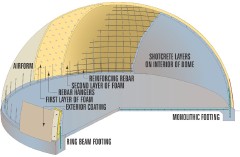 |
replaced at a reasonable cost. Consequently, a Monolithic Dome can usually be put back in use soon after the flood subsides.
Depending on the depth and rate of flow, flood waters can shift or move a structure.
Because of the Monolithic Dome's large mass (weight), it would take a substantial amount of pressure to shift it -- far more than the pressure that could move most conventional structures. A dome's rounded surface also helps split the water around the building, mitigating the total pressure.
So, can a flood actually move a Monolithic Dome?
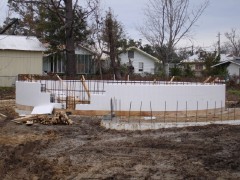
A dome is shaped like a bowl. If the dome is attached to the ground and the water cannot get under the bowl, the dome will stay in place -- assuming that it stays watertight.
Once water begins seeping under the dome, the pressure will start to equalize, and it will lift the floor of the dome. This is especially true if the water gets more than a couple of feet deep.
If the flood water moves horizontally with force, the dome's weight will make a big difference as to whether it slews or slides.
In general, as water continues to rise over the outside of a dome, it breaches doors and windows and fills the structure. If the dome has a top without windows or air leaks, it will act the same as a plastic kitchen bowl half full of water: it will start to lift.
If the water inside the dome rises significantly above the tops of the windows and doors, trapping a significant amount of air inside the dome, the dome will tend to pick up.
 |
Here's an easy demonstration of what can occur to a Monolithic Dome in a flood: fill a sink with water; place a plastic, kitchen bowl upside-down into the water.
Monolithic Domes can be easily built with large openings in the lower level to allow flood water to pass through the structure. The upper floors can then be designed to be above the flood stage. The Monolithic Dome is strong enough to support the upper floors from the shell. Thus flood waters do not have any internal supports to sweep away. This design is especially useful in areas where flooding is expected.
Related Links:
- Wind, Water and Monolithic Domes
- The Monolithic Dome
- Free Information
- The Monolithic Dome
- Concrete and Steel: Complementary Opposites
- Timeline for Monolithic Dome Construction
- Who We Are
- Frequently Asked Questions
- From Toothpicks to Trailblazing-- Birth of the Monolithic Dome
- The Monolithic Dome-- Not a Square Idea
- Index of Larger Monolithic Dome Projects -- Partial List In Alphabetical Order by State
- We've Got Mail
 Think Round, The Story of David B. South and The Monolithic Dome
 - Brand New Information Pak and Video!!!
 |
|