

Monolithic Introduces New, Monolithic Airplane Hangar Door
Updated May 10, 2006
by David B. South
On the inside of the Monolithic Dome Hangar, the door hangs from a curved, overhead track. While the door gets its guidance from the overhead track, the door's bottom rests on rollers that provide support.
Advantages
Since the Monolithic Hangar Door is one piece, it's easier to seal when shut and totally protected when open inside the dome.
Its one-piece design also means the door can be as heavy as necessary, and still be easily moveable. Smaller doors can be opened and closed by hand; larger ones by motorized rollers or wheels.
The door's curved shape naturally resists wind pressure. Wind against the door, cramming it tighter into the opening, is not a problem. Wind uplift is not a problem either because the door is larger than its opening, so it cannot be sucked out through the opening.
Because of the door's design, the hangar's opening can be shaped to more closely imitate the shape of an airplane. It can be significantly wider in lower areas and narrower at the top for the tail. This means that less of the hangar dome -- the structure's strongest part -- can be cut away and the area for the door can be smaller. Hence, the Monolithic Dome Hangar and its unique door can provide ultimate protection and still be less costly to construct and operate.
|
|
Quicktime Movie by Jim Kaslik of Cloudhidden Designs. |
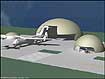
Monolithic recently designed an airplane hangar door, tailored for Monolithic Dome Hangars, that is not only stronger and safer than currently available, conventional doors but also affordable. We expect the new door to significantly enhance an aircraft's safety while it's housed in a Monolithic Dome Hangar.
Note: On March 21, 2006 David B. South was issued U.S. Patent 7,013,607 for his invention: the Monolithic Contoured Laterally Moveable Access Door.
Problem: Weakness of Conventional Hangar Doors
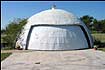
People build hangars for only one reason: to protect the airplane -- their major investment -- from natural and manmade disasters, such as high winds, tornadoes, hurricanes, earthquakes, fire, burglary, sabotage, etc. Because of their innate strength, Monolithic Dome Hangars most efficiently provide that kind of protection.
But the weak point of any hangar is its door. To date, hangar doors have been designed to be large, yet light enough for easy opening and closing. Three currently popular ones include single-fold lifting doors, bi-fold lifting doors, and sliding doors that stack to the side.
Opening or closing such doors during high winds could lead to their destruction. Then too, strong winds can damage them, penetrate the hangar and harm the aircraft within.
We here at Monolithic decided that equipping a Monolithic Dome Hangar with a conventional hangar door would severely compromise the dome's strength and safety.
Solution: Invent The Needed Door
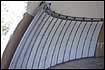
Monolithic designed a one-piece hangar door that is curved in three dimensions. It does not open by lifting overhead or stacking itself into sections. During the opening process, the Monolithic Hangar Door remains in one piece and simply rotates itself to the inside of the Monolithic Dome Hangar.
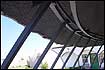
On the inside of the Monolithic Dome Hangar, the door hangs from a curved, overhead track. While the door gets its guidance from the overhead track, the door's bottom rests on rollers that provide support.
Advantages
- Since the Monolithic Hangar Door is one piece, it's easier to seal when shut and totally protected when open inside the dome.
- Its one-piece design also means the door can be as heavy as necessary, and still be easily moveable. Smaller doors can be opened and closed by hand; larger ones by motorized rollers or wheels.
- The door's curved shape naturally resists wind pressure. Wind against the door, cramming it tighter into the opening, is not a problem. Wind uplift is not a problem either because the door is larger than its opening, so it cannot be sucked out through the opening.
- Because of the door's design, the hangar's opening can be shaped to more closely imitate the shape of an airplane. It can be significantly wider in lower areas and narrower at the top for the tail. This means that less of the hangar dome -- the structure's strongest part -- can be cut away and the area for the door can be smaller. Hence, the Monolithic Dome Hangar and its unique door can provide ultimate protection and still be less costly to construct and operate.
Related Links:
- The Monolithic Door: Its Possibilities Surprise Even Its Inventor
- Protect Your Investment
- Hangin' in There-- Monolithic Dome Airplane Hangars
- Where will airline companies house the new Airbus A380?
177
Dome Park Place - Italy, TX 76651
Tel (972)483-7423 - Fax (972)483-6662
 | Press Room