

Randy
John South
The Challenges of Dome Building
Updated March 2008
By: Freda Parker
Note: The article that follows was written in 1999. Since then, Randy established South Industries, Inc. a company headquartered in Menan, Idaho that specializes in the construction of Monolithic Domes.

Ask Randy South, President of South Industries, what's the fun part of a Monolithic Dome project, and he answers without hesitation. "Hanging the rebar," Randy says, "because you're shoulder-to-shoulder with the other workers and you can tell jokes, or discuss dinner and just enjoy each other's company."
But ask the 45-year-old Randy, who has more than twenty years of Monolithic Dome building experience, what's the most challenging part of a project, and he becomes considerably more thoughtful. "New projects are always challenging," Randy says, "till you do them once and then you learn.
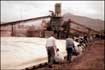
"There's been lots of challenges," he continues. "The bigger the domes get, the more challenging they are. It seems like every time we do a project, it's bigger than the last. So each one has its unique set of challenges that come with it. Size can be a challenge, or the height, or the crane and equipment needed-almost anything, really."
Randy's Monolithic Dome enthusiasm began in his teens as he worked with his brothers David and Barry spraying polyurethane foam insulation. He says, "We found that after we insulated a building, and then sprayed a little bit of concrete on the inside of the insulation to make a fire barrier, it added so much strength to the building that we didn't really need the building anymore."

Recalling those beginnings, Randy says, "I think we (David, Barry and Randy) were all equally enthusiastic about this combining of foam and concrete and what that could do for a building. We were probably spraying more polyurethane than any other contractor in our area, at that time. Many of our projects were storage facilities. We could see the tremendous need for better storage structures for products like potatoes. We wanted to build something a lot more efficient. And that was the challenge then."
The Souths met that challenge by inventing the Monolithic Dome. Randy fondly remembers their first project. "It was a Monolithic Dome with a diameter of 105' and 35' tall, built in 1975 in Shelley, Idaho for potato storage."

That structure no longer holds potatoes, but is still very much in use as a waterbed factory.
To date, Randy has overseen hundreds of projects. But, somewhat like a parent who loves his children equally and refuses to pick a favorite, Randy claims that he doesn't really have a pet project. "What I like best," he says, "are the jobs that require pioneering - invention. For example, we had to find new ways of handling shotcrete.
"You know the old saying: Necessity is the mother of invention. That's very true in this business," Randy says. His new methods for shotcrete handling included finding safer, more efficient ways in which to spray as well as better equipment. They even included designing a new hardhat.

"Most people don't spray shotcrete over their heads," Randy says, "so they don't need anything to protect the head and face. But we do. So, I had to come up with some way to spray over your head and still protect yourself. You don't want that stuff in your face or in your eyes or on your head." Randy's solution is a hardhat with a special, changeable shield.
At the 1999 Monolithic Dome Builders Conference, Randy presented two of the workshops. In the first of these, titled Large Domes In Far Away Places, he discussed bulk storage domes that required new designs and creativity:
- Intradivided domes with curved walls and bins on the inside.
- Domes with inside conveyors, used to move their contents.
- Domes with an airslide reclaim system. The floor of such a dome is covered with a fabric that has holes only large enough for the passage of air. Air blown up through this fabric moves the dome's contents-usually cement - to where it can be vacuumed out and loaded for transporting.
- Domes with a gravity feed reclaim sys-tem, consisting of cones that move the contents down to a conveyor.

The far away places in which Randy has managed Monolithic Dome construction include Russia, Latvia, Germany, Jordan, Iraq and others. Recently, in the United Arab of Emirates, the world's largest clinker cement storage facility was built. A Monolithic Dome of 200' in diameter and 130' in height.
"We had four people supervising, teaching and working with a native crew of sixty Indians," Randy recalls. "The average weight of the native workers probably was about 120 pounds. But they worked well."
Communication can be a problem in foreign projects. "In some parts of the world, you just have to have an interpreter," Randy says. "We always do a lot of sign language. Fortunately, our people are very good at show-them-how-to-do-it. So, we go out there and show them."
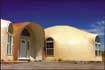
But though his subject matter might be serious, Randy has a well-honed sense of humor that quickly wins his audience. Asked if he was the youngest of the three South brothers, Randy quips, "Yes, I'm the youngest - and the best looking -and the most charming, etc. etc."
Randy does much of the hiring, and says that, in addition to skill, he looks for "people who are not afraid to get out there and work and flex their muscles, sweating and doing hard, physical labor. They also have to like the idea of traveling from place to place."
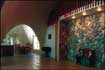
As for the Monolithic Dome industry, its present and future, Randy says, "I'm not surprised that it's catching on, but I am surprised that the catching on didn't go faster because the dome is such a fantastic product."
"But," he concludes, "I think we're just at the edge of falling off a cliff. I think we're going to explode. And that will be our next challenge."
Related Links:
177
Dome Park Place - Italy, TX 76651
Tel (972)483-7423 - Fax (972)483-6662
 | Press Room