

Why the
Crenosphere Was Invented
by David B. South
Renderings by Rick Crandall
 David B. South, President of the Monolithic Dome Institute |
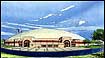
The Monolithic Dome is a thin-shell structure, meaning that it’s made of a thin shell of concrete. As that thin shell is built bigger and bigger, its radius of curvature gets bigger.
The radius of curvature is the flatness of the thing. For example, the radius of curvature of the hood of a car is a big number. But the radius of curvature of the car’s fender is a smaller number because there is less flatness in the fender than in the hood. A kid jumping on the car’s hood would probably dent it, but jumping on the fender probably would not hurt it.
Here’s what that means to a Monolithic Dome: As the Monolithic Dome gets bigger and bigger, it gets more like the hood of the car, and eventually suffers from what’s called snap-through buckling.

Besides the snap-through buckling, the inflation of the Airform for a really huge dome is a problem. To create the shell, we inflate the Airform. But with huge domes, the fabric can’t take the pressure and rips.
So, if we want a thin-shell dome with a diameter of 300 feet or more, it cannot be a Monolithic Dome.
But we can build thin-shell domes as Crenospheres whose diameters range from 300 to 1000 feet. The construction process used in the Crenosphere solves the problem of snap-through buckling and the problem of the Airform ripping.
This construction process is the primary difference between a Crenosphere and a Monolithic Dome; that difference made getting a patent possible.
Here’s how it goes: Before the Airform for the Crenosphere is inflated, a steel cable net, slightly smaller than the Airform, is fastened over the Airform. Inflation forces the Airform’s fabric to pillow out between the cables. A series of connected, smaller domes is formed. The Airform does not rip because pressure is transferred from the fabric to the cables.
With inflation completed, construction moves to the inside of the Airform. The Airform’s interior is first sprayed with polyurethane foam, then crisscrossed with rebar ribs, and sprayed with concrete. The ribs give the Crenosphere shell more depth, but not weight, and they create row upon row of small domes, eliminating the problem of snap-through buckling.
The construction technique for Crenosphere Domes makes it possible to build very huge, very durable structures, with clear-span interiors much more affordably than ever before. The Crenosphere’s other advantages include a life-span measured in centuries, superior insulation, low energy consumption, low maintenance, reduced construction time, disaster survivability and affordability.
Related Links:
- Reinforced Concrete Thin Shell Sports Facilities
- Metropolitan Pennsylvania Considers Monolithic Dome Special Events Facility
- Arenas and Ice Rinks
- Cost Estimates for Simple and Professional Monolithic Dome Rinks and Arenas
- The Crenosphere Stadium-- The Ultimate Sports Facility
- Crenosphere-- A Dream Come True
- Arena Football League-- Its Popularity Is Skyrocketing
- Commercial Feasibility Study
 |
|